

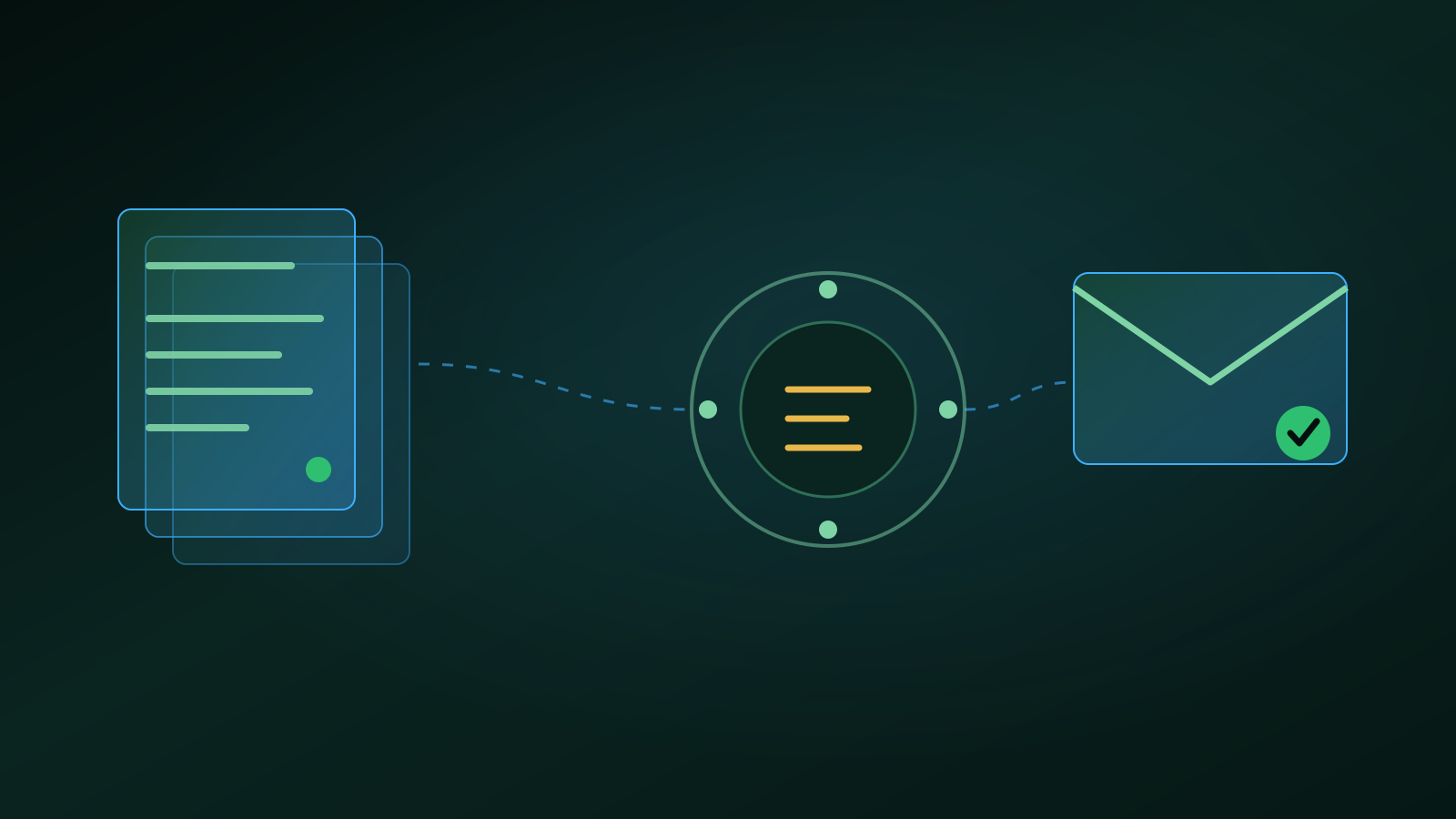
An AI without a source guesses. Connect your own FAQ and pages to your inbox and it returns the answer you approved, with the source attached.
A customer emails with a question about what is available at the location. The system checks the customer file, finds nothing about it, and produces a draft that talks around the subject. Meanwhile the answer is simply on the website, three clicks away, in four languages.
That is exactly the gap most AI applications in customer service fall into. The model knows the ordering system and nothing else. Everything your company knows and has written down stays out of reach.
An AI without a source guesses
It helps to understand why this goes wrong, because it is not a malfunction.
A language model produces the most likely continuation of a piece of text. When it does not know something it does not fall silent, it fills the gap with something that looks right. In a conversation with a colleague you notice. In a neatly formatted draft email to a customer you do not, and that is the dangerous case.
The answer is not a bigger model. The answer is to leave the model no room to guess, by handing it the right passage from your own material.
Three sources with every message
In a recent project I built this out of three layers that each know something different.
The first is the customer file: what did this person book or order, when, for how much and what is the status. That is hard data and the system already had it.
The second layer is new and the most valuable: the website itself. With every incoming message it looks up which published questions match this customer's wording, and which pages relate to what they booked. Those passages go along as a separate block in the instruction to the model.
Two rules keep that reliable. Only published texts count, because a draft is not an answer you stand behind. And the search runs across all available languages, after which the best language version per question is used. A German customer then gets a German answer resting on the same source as the Dutch one.
The third layer is the delivery of your own email. If a customer says they never received anything, the system can see whether the message was delivered, when, and whether it was opened. That is one of the more unpleasant conversations in customer service, and it is settled with facts in a single sentence.
Turning the question around
The nicest effect only appeared later. If you keep track of which questions come in that the website has no answer for, you do not have a problem, you have a list.
There is a separate overview for that next to the task board. It collects structural improvement points surfacing from the mail traffic: a question asked five times a month and answered nowhere, a delivery problem that repeats, a payment that keeps raising queries.
That turns customer service into a source of content instead of a cost centre. Every frequent question you put on the site is a question you no longer answer by email. And it is immediately material for the FAQ with structure to build on.
A human presses send
This belongs here, and not as a disclaimer.
The draft sits ready in the message, with the sources used alongside so you can see where the answer came from. A colleague reads it, adjusts whatever needs adjusting and sends. Nothing leaves the building that nobody has seen.
In practice the work shifts from writing to checking. That is a different kind of work, and it is considerably faster. It is also more pleasant, because the awkward questions are exactly the ones the system has already gathered facts for.
What you need for it
Three things, and none of them is a large project.
You need a website whose content can be read by a system other than the visitor's browser. That sounds obvious and is not: on many sites the text is locked inside the styling.
You need ordered answers. One long page holding everything produces poor passages, separate questions with a clear heading produce good ones.
And you need an inbox connected to the system, so an incoming message can be tied to a customer and a file.
Once that is in place, the rest is plumbing. The model is the least remarkable part of it.
Read also
- AI draft replies in your inbox: the answer is ready, you press send, the foundation this builds on
- From meeting to task list: how a recording writes itself up, the same approach applied to meetings
- View all completed projects, web platforms and automation solutions
Bert
Frequently Asked Questions
- Why does an AI invent answers when you give it no source?
- A language model is built to produce the most likely continuation of a text. When it does not know something it does not stop, it fills the gap with something that sounds plausible. Give the model the right passage from your own website and it has nothing to invent, and it can name where the answer came from.
- Which texts from my site does such a system use?
- Only what is published. Drafts, internal notes and expired pages stay out of reach, because otherwise you send a customer something you do not stand behind yet. Per message it looks up the questions and pages relevant to that customer and their file, not the entire site.
- Does the system send email to customers by itself?
- No. The answer sits ready as a draft in the message. A colleague reads it, adjusts whatever needs adjusting and presses send. That takes a fraction of the time of writing it yourself, and nothing leaves the building that a human has not seen.