

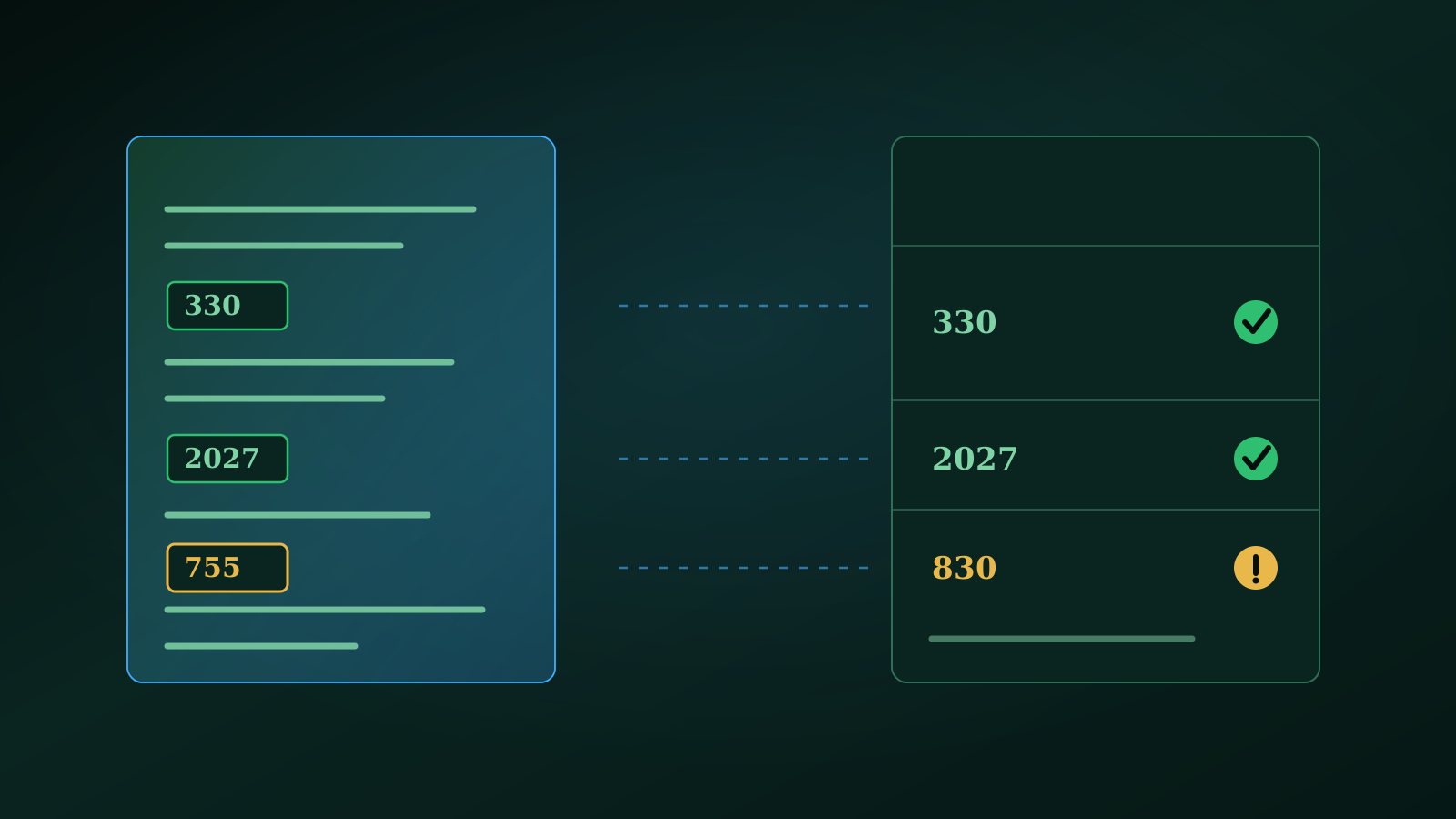
Everyone updates the price list. The sentence in your FAQ containing that same amount, nobody updates. How to hold those numbers against your own system automatically.
Everyone updates their price list. A new season arrives, the rates go up, and within ten minutes the system holds the right amount.
The sentence in your FAQ containing that same amount, nobody updates. It was written two years ago, it sits on a page you never visit, and from now on it tells your visitors something that is no longer true.
The problem has grown, not shrunk
This has always been the case. What has changed is who reads your copy.
A search engine that handed back a list of links could do you little harm. An AI assistant that summarises a visitor's question does something else. It takes the sentence containing an amount and serves it as the answer, without putting the price table beside it. If that amount is out of date, it is now your official price as far as the machine is concerned.
That is what your visitor turns up with at the counter. And you have no case, because it was on your own site.
Facts sit in five places at once
Once you start looking, the spread is striking. A figure sits in the body text, in an answer to a frequently asked question, in the meta description, in a category description and sometimes in the alt text of a photo.
Multiply that by your number of pages and your number of languages. At sixty location pages and four languages you are looking at more than two hundred documents that may contain a price, a year or a surface area. That is not a job you schedule for an afternoon. That is a job that never happens.
How others solve this
Before building anything I looked at how organisations with a lot of documentation handle it. Three approaches came out, and all three are usable.
The first is a verification date in the metadata. Microsoft does this in its documentation: every document carries a date on which it was last reviewed, and a weekly scan raises a task of its own as soon as that date gets too old. The lesson I took from it: the date is a trigger, not a licence. Bumping it without looking is worse than leaving it alone.
The second is one source for every fact, embedded everywhere rather than retyped. Technically the most elegant answer, in practice rarely workable for running text that has to read well.
The third is comparison: the facts are already in a system, so put the text beside it and report the difference. That became the route, with the verification date wrapped around it.
What the check does
A nightly pass walks through the copy and pulls out the numbers: amounts, years, counts, surface areas, dimensions and records. It holds those against what the system knows, per page and per language.
If they differ, a finding appears with the surrounding sentence included. That last part is the difference between a usable report and a list nobody opens. A message saying "figure differs" tells you nothing. A message with the whole sentence beside it lets you decide in two seconds whether it is wrong.
Every finding comes with a proposal. Sometimes that is removing the amount. Sometimes it is replacing the amount with a pointer to your price overview, so the figure lives in one place. Sometimes it is rewriting a year, or naming a quantity without the exact number.
The sharpness is in the boundaries
The trap with a check like this is not that it misses something. The trap is that it reports too much. A list of two hundred findings of which a hundred and fifty are nonsense is worse than no list, because everyone stops looking.
So every rule is drawn tightly. Take a record figure. The sentence "specimens up to twenty kilos" describes what a visitor can expect. The sentence "the record stands at twenty-nine kilos" is a claim about a figure held in the system. Only the second one counts. Test both and every honest description becomes a finding.
The same goes for years. A year in a pricing arrangement has to be right. A year in the owner's story about how he started is history, and you leave it alone.
Units belong to the market
One detail that pays off surprisingly well: converting to the unit of the country. A surface area listed in hectares on the Dutch site belongs in acres on the English one. A weight in kilos belongs there in pounds.
That is not cosmetic. A visitor who sees a figure in an unfamiliar unit has to do arithmetic, and a visitor who has to do arithmetic leaves. So the check looks not only at whether the figure is right, but at whether the unit fits the language.
What it gives you
Two things, and the second matters most.
The first is that your content ages more slowly. Change a price and within a day a list shows which sentences are about it, in every language, with a proposal attached. What used to be a week of manual work is an hour of ticking off.
The second is that you dare to put figures back in your copy. Concrete numbers make a text convincing and search engines pick them up. The reason many companies leave them out is fear of deferred maintenance. Remove that fear and you can write more sharply.
What it is not for
A fact check tests what your system knows. It does not test opinions or promises. "The friendliest service in the region" cannot be verified by a machine, and it does not need to be.
And it does not replace an editor. It makes sure the editor spends their time on the text, rather than on checking whether a three-year-old figure still holds.
Read also
- An FAQ that genuinely helps customers, and that AI chats can read, on the structure this leans on
- Invisible characters in AI text: measuring, cleaning up and why it still pays, on making text quality measurable
- View all completed projects, web platforms and automation solutions
Bert
Frequently Asked Questions
- Would it not be easier to keep amounts out of your copy altogether?
- That is the safe route, but you give something up for it. A concrete figure makes a text convincing, and search engines and AI assistants pick up exactly those sentences. The problem is not the number, it is that nobody maintains it. Solve that and the number can stay. In places where a price really does move often, a pointer to your price overview is better: then the amount lives in one place.
- How do you stop a check like this from raising false alarms everywhere?
- By drawing its boundaries tightly. In our case only a sentence that genuinely states a record or an average counts. A phrase like 'specimens up to 20 kilos' describes what you can expect, not a record figure, and holding that sentence against the field would turn every honest description into a finding. Beyond that, the check never edits anything itself: it proposes, with the surrounding text included, and a human ticks it off.
- Does this work if your site runs in several languages?
- That is precisely the reason to automate it. With four languages every figure sits on your site four times, and by hand one is always forgotten. The pass takes all languages of a page in one go, including the languages where nothing was found, so a correction is never left half applied. Units travel with it: what is listed in hectares at home belongs in acres on the English site.