

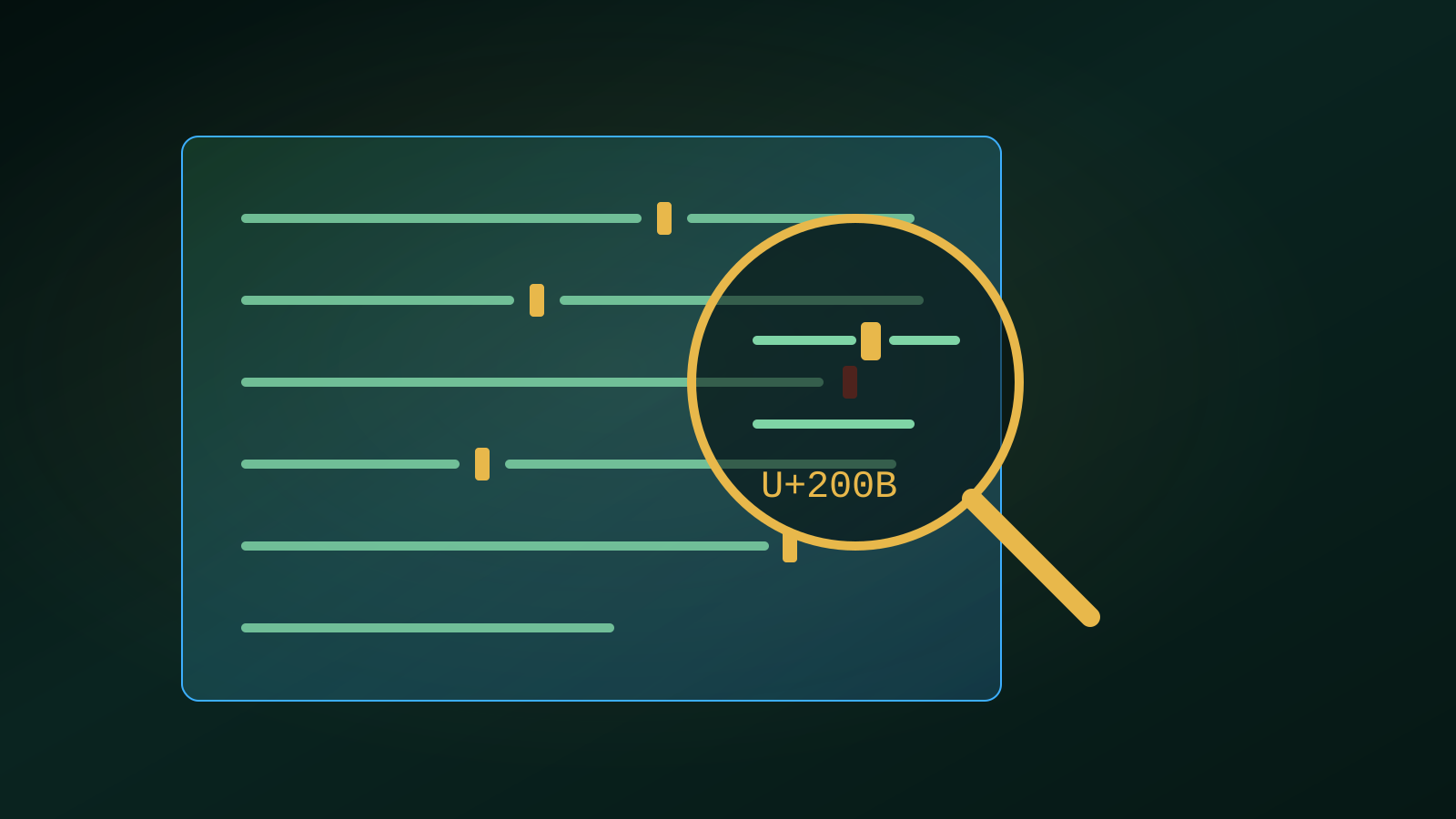
Paste AI text into your website and more comes along than you can see. On invisible characters, a meter that finds them, and why you take them out.
You have an AI write a piece of text, read it over, adjust a few sentences and paste it into your website. On screen it looks fine. In the source code there is more than you can see.
Between the words sit characters with no width and no meaning: a space zero pixels wide, a dash that looks like an ordinary dash but is not, a quotation mark from a different character set. They are invisible to the reader and perfectly visible to anyone running the text through a check.
Where those characters come from
Large language models can build patterns into their output that are traceable afterwards. Sometimes that is deliberate, as a way of showing that a text came from a model. Sometimes it is a by-product of how text gets assembled and copied around.
For you as a publisher that distinction hardly matters. The effect is the same: there is debris in your text that you did not put there.
Why you take them out
There are three reasons, and the first has nothing to do with AI.
Invisible characters are simply pollution. They break the search function on your own site, they cause odd line breaks in emails, and they surface as question marks the moment a text passes through another system. That is a problem you would want to solve even if AI did not exist.
The second reason is that outside parties measure for it. AI content detectors look at this explicitly. Whether their verdict is sound is another matter, but your client or your customer can end up holding a report you have to respond to.
The third is the quality of the text itself. And that is the interesting part.
It is not only about characters
A watermark is the easy half. The hard half is the writing style.
AI text has recognisable habits. Long dashes where a comma belongs. Sentences opening with "Moreover". Mirror constructions of the "not only this, but also that" kind. Words like seamless, powerful and future-proof, which promise a lot and say nothing. Paragraphs of precisely equal length.
None of that is an error, but it reads like a template. Readers feel it even when they cannot name it, and they drop off. That is a reason to deal with it that has nothing to do with any detector.
A meter across the whole site
In a recent project I built tooling for this. It started small: a button per page that returned a percentage.
That did not work well enough. A page an external detector scored high on came out at zero percent on ours. The measurement only looked at the body text, not at the title, the summary and the meta fields. Those are exactly the parts most often pasted straight out of an AI.
The second problem was the report. It gave a percentage but not what it was about. On a page with a French place name it produced a warning nobody could judge, because an accent is not a watermark.
What the fix delivered
Three changes made it usable.
The measurement now covers the full source of a page, title and meta fields included. An article that kept sitting at two percent with no button helping turned out to have its entire signal in the title.
The report names the character itself: the official name, the code point, and the surrounding text. That lets you see in two seconds whether it is a real watermark or an ordinary accented letter you should leave alone.
And an overview arrived covering the whole site, in every language at once, with a filter for "signal only". That turns the work from taking samples into working through a list. On saving and after a translation pass the carriers found are removed automatically, only for the parts that actually changed.
Why this still pays off for now
To be fair: it is a moving target. Models change, detection tools are unreliable in both directions, and nobody can say with certainty what a search engine will do with this a year from now.
It remains sensible anyway, for a simple reason. The cost is close to nothing. Measuring happens automatically, cleaning is one button, and the style check is something a good editor does regardless. Against that sits a risk you cannot judge and can remove in half a day.
And the main point holds whatever detection tools do: text that is clean and sounds like a person wrote it reads better. Your visitor benefits from that today.
Read also
- What AI really means for your SMB (without the hype), where AI does and does not belong
- From building to securing: a week without new features, on maintenance you do not see but do notice
- View all completed projects, web platforms and automation solutions
Bert
Frequently Asked Questions
- What is an AI watermark in text?
- A collective term for traces a model leaves behind in text. Usually these are characters you cannot see on screen, such as a zero-width space or an unusual variant of an ordinary punctuation mark. On top of that there are style traces: a preference for certain dashes, sentence patterns and stock phrases that are rare in human writing.
- Is it wrong to use AI when writing?
- No. Cleaning up watermarks is not about hiding that AI was involved, it is about the quality of what you publish. Invisible characters do not belong in your source code, and text that reads like a template reads badly regardless of who wrote it. A human should go over the work before it goes live.
- Do search engines recognise AI text by those characters?
- There is no certainty about that, and detection tools contradict each other. What is certain is that search engines steer on usefulness and originality. Publishing clean text takes little effort and removes a risk you cannot otherwise judge, so for now it is a sensible habit.