

On a German page a visitor read a translated quote above a list of Dutch texts. How to fix that without touching a single word your guest wrote.
Reviews are the most convincing texts on your website, and the only ones you did not write yourself. Which is exactly why it is so awkward when they sit there in the wrong language.
On a recent project it was half sorted, and that is the worst of the three possible situations. At the top of the German page sat a translated quote from a guest, and underneath it a list of reviews in Dutch.
Half translated is worse than not translated
If nothing is translated, a visitor understands that. They see a list in a foreign language and think: those people came from another country.
With half translated they think something else. They see one fluent German recommendation above fourteen texts they cannot read, and that reads as a hand-picked quote. Not as a guest's opinion, but as an advertising line. That is the opposite of what a review is supposed to do.
And there was a second problem underneath: the quote on the card and the list on the page came from two different sources. One of them translated, the other did not. That kind of difference always arises that way, and it was never a choice.
The rule: say that it is a translation
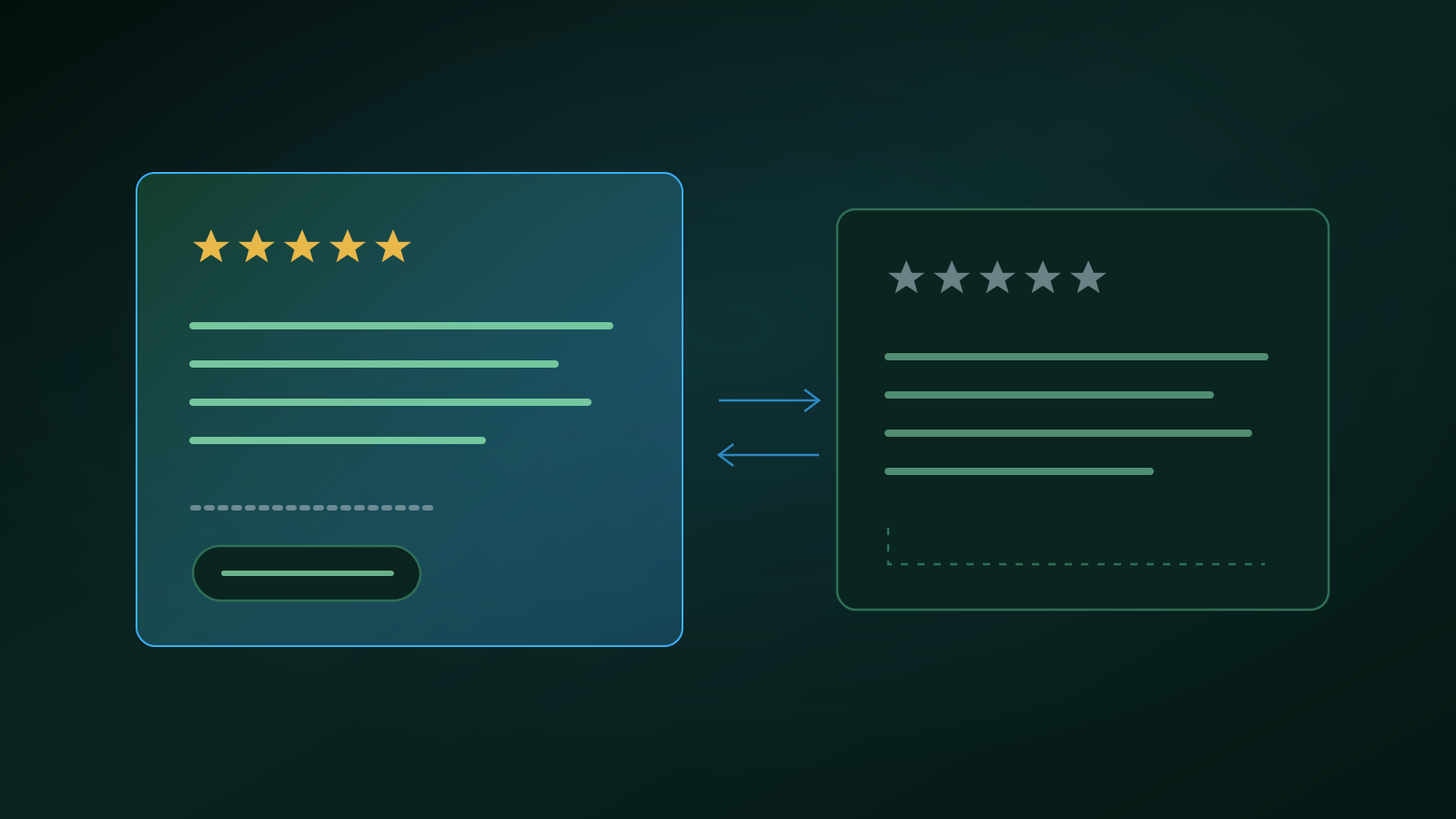
Underneath a translated review it now says which language it was translated from, in the reader's language, with a button to show the original.
Two details make the difference. The attribution swaps along with it: as soon as the reader calls up the original, the "translated from" line disappears, because that notice does not belong above a guest's own words. And both texts are already in the page, so the browser does the swapping without fetching anything. If that button does not work, for whatever reason, the translation stays. A reader always gets something to read.
On a small card there is only the attribution and no button. There is no room for it there, and the original is one click away on the page itself.
One stock, and the guest's text stays untouched
The translations live in one place, which both the website and the booking widget read from. That is the dull but most important decision in this whole piece: as long as two components maintain their own translation, they will drift apart.
The guest's original text is never touched. It sits in its own field and stays there, however often a translation round passes over the rest.
Four safeguards on the translation round
A round running unchecked over customer text is a risk. So there are four limits on it.
An empty result is never saved, because a failed translation stored as a translation never leaves your screen again. A manually set translation is never overwritten, because somebody looked at that for a reason. A review already written in the target language keeps the guest's own words. And the source text gets a fingerprint, so an edited text returns to the list by itself and the translation does not quietly fall behind.
There is no silent fallback to a different translation engine. Whoever picks the engine picks it, and if it is down nothing happens instead of something unidentified.
What to leave alone
This is where it got interesting. The system's text scanner flagged an odd character and a few dashes on a page, and they sat inside the words of two guests.
The character was an old emoji from a phone's private range. No clean-up button removes that, and rightly so: they are somebody else's words. The fault was not in the text but in the measurement. It is supposed to skip customer quotes, but the rule recognised only one of the three ways a quote appears on the site, and since the quotes on the cards started rotating it no longer saw two of them.
That is a principle reaching further than reviews. Your rules for text quality apply to text you write. At a customer's own words they stop, and your tooling has to know that.
The bug that shut customers out
One more lesson from the same corner, and a painful one. Customers on the English site could not post a review at all. Every attempt produced the same message: the review could not be posted, please try again.
That was the invisible bot protection that had replaced the visible captcha earlier. Of its three checks the time threshold was firing: the form records a timestamp when it opens, and submission is refused if that is missing. On the language domains the form is loaded from a different domain than the page itself, and then that timestamp is not there.
The measure was well thought out and had not foreseen one case, and that case was a real customer you want to leave you a review. An invisible check is only as good as its worst case, and that case must never be a legitimate customer.
What it gives you
Three things, and the third is the reason to start.
A visitor who does not read Dutch can now read what earlier guests thought. That is the direct gain, and for a stay or a service where trust is decisive, that is the most convincing piece of text on your page.
Search engines get real content in every language, instead of a block of text that means nothing in that language.
And you can explain what you did. A translated review with attribution and the original within reach is defensible to a reader, a guest and a regulator. A translated review without those two things is not, even if the translation is perfect.
Read also
- An FAQ that genuinely helps customers, and that AI chats can read, about the other texts that build trust
- Invisible characters in AI text: measuring, cleaning up and why it still pays, about the scanner that had to learn to look away here
- View all completed projects, web platforms and automation solutions
Bert
Frequently Asked Questions
- Are you allowed to translate a customer review?
- Yes, on two conditions. You state that it is a translation and which language it came from, and the original stays readable with one click. What you must not do is adjust the content: no correcting spelling, no softening the tone, no dropping a sentence because it is less flattering. The moment you do that it stops being a review and becomes advertising, and a reader senses that difference sooner than you would think.
- What do you do with odd characters or typos in a review?
- You leave them. In our case the text scanner flagged an old emoji from a phone's private range and a few dashes inside the words of two guests. That is not pollution you clean up, that is how somebody writes. So the change was not in the text but in the scanner: it is supposed to skip customer quotes, and for two of the three kinds of quote block it no longer did.
- Is machine translation good enough for reviews?
- For the meaning it usually is, and that is what counts: a reader wants to know what an earlier guest thought. Three rules keep it honest. The original stays one click away, a manually set translation is never overwritten, and the source text gets a fingerprint so an edited text has to be translated again.