

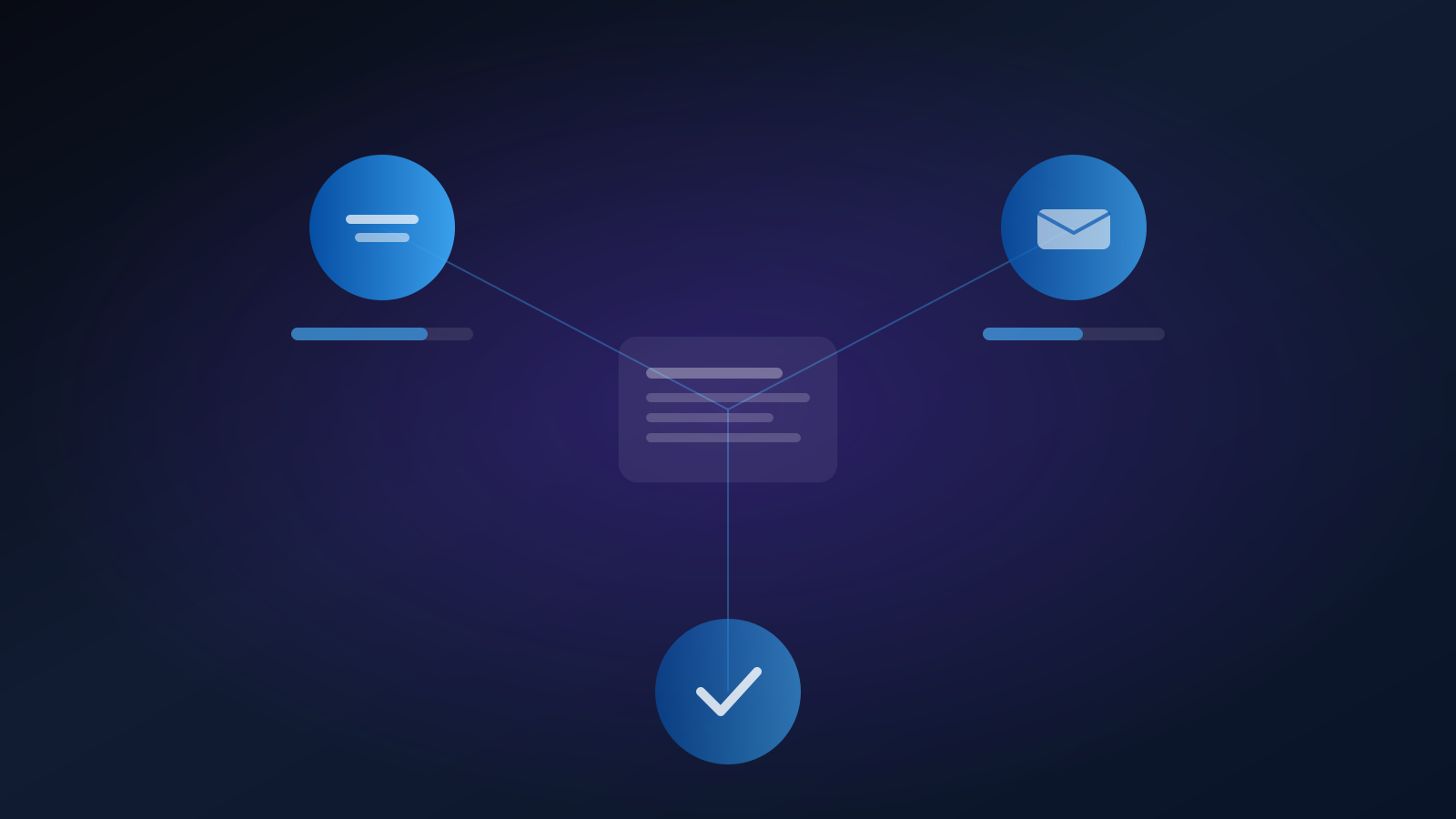
An admin assistant, a writer of draft replies and a builder and tester, each with its own task and memory. On dividing the work, and on where an AI personality stops.
It started with one AI assistant in the admin of a booking platform. It was given a memory and layers so it can be trusted. By now there are three, each with a task of its own.
That was not a plan in advance. It happened because one assistant doing everything turned out to be impossible to follow on anything. This is what the division looks like, and where we deliberately drew a line.
Three tasks, three measures of success
The admin assistant answers questions from staff in the admin. It looks up bookings, reads the handbook and the logs, and learns from corrections.
The writer of draft replies prepares a draft reply for every incoming customer mail. A staff member checks it and sends it. It never mentions itself or the team in a text to a customer.
The builder and tester picks up test tasks and small bugs from the task board. It investigates, tests, and approves or has a bug built. Write steps in the system always go through a person.
The big advantage of this division is that each task gets its own measure. For the writer, the system records per draft what happened to it: sent unchanged, edited, rewritten, regenerated or not used. Rewritten means less than 35 percent word similarity with the draft. That shows per type of mail and per language where it misses most often. For the tester, the measure is whether its verdict is right, and whether an administrator approves or rejects its proposal. For the admin assistant, it is the thumb below every answer.
Three measures you cannot add up, and that is why they belong to three different agents.
Knowing who does what
Three agents that do not know about each other send questions the wrong way. So there is one shared text describing who does what, including the people: who handles customer contact, who decides on technical matters and who is responsible for the money chain.
All three read that text, each in the form that suits its work. The closing sentence differs per agent and is deliberately not a ban. The admin assistant may still draft a mail when a staff member asks for it; it just knows better where something ends up.
A diary made of facts
The agents each keep a short daily review. That sounds like a gimmick, but it works as memory at a higher level: not a single lesson, but what happened that day and what it says.
The most important rule: the review comes only from facts in the system. For the tester, those are its completed rounds and the administrator's verdicts. For the writer, what happened to its drafts. A day without facts becomes a quiet day without any call to the model; nothing is made up to fill the day.
Everything is cleaned before it is stored: no e-mail addresses, phone numbers, booking codes or amounts. The last three reviews go along in the admin assistant's instructions, with the instruction never to tell what a colleague asked. And a self-image of four paragraphs is rewritten at most once a week; never replaced by an empty or too short answer, and a new version is always a new row.
Where personality stops
The admin assistant got a name, one it chose itself. It keeps notes on how colleagues like to work, and asks itself questions it looks into later. That raised a question I found more interesting than expected: how far do you go with this?
The first version answered "how are you?" with a label and a reason: "calm, reason: ..." That was because its state was supplied as a status line. Now it gets the facts of its day, and how it answers is up to it: an ordinary sentence in its own words, the reason only if someone asks. Ask for its opinion and you get its real opinion with arguments, even if it differs.
The line is at feelings. It claims no emotions it cannot support. The calculated state (cautious after three thumbs down in 24 hours, brief when busy) steers how it works, not what it says it feels. Its own suggestion to build in a fixed sentence per state was deliberately rejected. That would make its answer a script again.
The assistant that says what it runs into
An unexpectedly useful part: every day the admin assistant writes down what it ran into. Not out of nowhere, but from the facts of 24 hours: tools that found nothing or were not allowed, refused actions, outages, sentences in which it said it could not do something. Per point, an administrator chooses: fix this, accept, or later.
That brought a series of blind spots to light. It could not open the website and so did not know what was actually on it. It did not know what had changed recently. It did not see conversations outside the mailbox. Each of those points became a task, and most have been solved by now.
What I take from this
Split an AI assistant as soon as you can no longer measure its tasks with the same yardstick. Give the agents a shared description of who does what. Let every memory, including a diary, consist only of facts. And with personality, draw the line at what it can support: an opinion with arguments, yes; feelings, no.
This is the last in a series of ten posts about what I built on this platform over the past months. More is in the portfolio. If you are thinking about AI agents in your own company, I am happy to think along via the contact page.
Frequently Asked Questions
- Why several AI agents instead of one?
- Because each task has different data, different rules and a different measure of success. You measure a writer of customer mails by how often the draft is sent unchanged, a tester by whether the verdict is right. A single assistant doing everything cannot be followed properly on any of those measures.
- Do the AI agents know about each other?
- Yes, through a shared text in one place that describes who does what. That way each knows where something ends up. It forbids them nothing; they simply know better who a question belongs to.
- Does an AI assistant have feelings?
- It makes no claims about that which it cannot support. It may give its own opinion with arguments, but does not claim emotions. A state such as cautious or busy is calculated from facts and steers how it works, not what it says it feels.